Editorial source note
Election Day Vegan OMAD Mukbang: Rice & Black Beans!
Joe demonstrates a beans-and-rice one-bowl meal and argues that a complete setup and plate boundary regulate consumption. The mukbang also ranges into his case against diet dogma and echo chambers.
Related principles
An editorial summary of views Joe expresses in the linked video. The original recording remains the primary source for his full words and context.
Detailed notes
A closer look at the ideas, examples, and reasoning Joe presents in this recording.
A one-bowl meal inside an anti-echo chamber
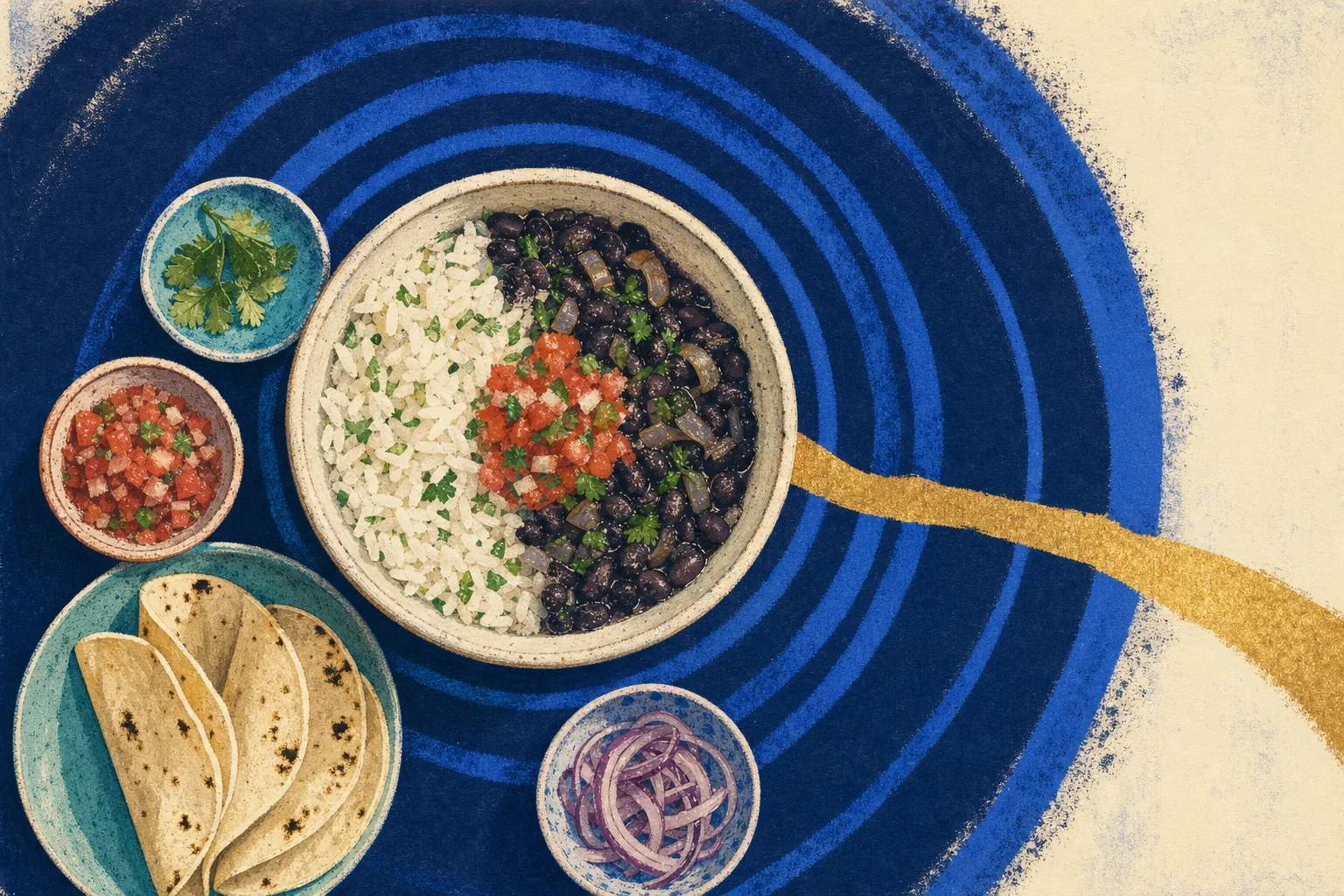
Joe’s meal begins with familiar staples: black beans and rice with onions, cilantro, corn chips, tortillas, homemade serrano sauce, and vegan cheddar-style shreds. He finishes with a shake made from almond milk, pea protein, a plant-based collagen product, and flaxseed. The food occupies only part of the recording; the rest ranges across diet dogma, disagreement, social media, and the value he assigns to an unpredictable life.
Cheap food with a visible boundary
Joe had cooked the rice in advance and heats canned beans for about five minutes. He values the combination because it is inexpensive, easy to assemble, and satisfying when approached without inflated expectations. He connects that attitude to what he calls perpetual reverence: ordinary food feels sufficient when it is not required to deliver spectacle.
The large bowl functions as the meal’s boundary. Joe says everything should be ready before he sits so that the meal does not expand through repeated trips for another item. He claims that stretching the sitting to forty-five minutes or an hour leads to substantially more food than a bounded plate or bowl would.
Those timing and consumption claims reflect Joe’s experience, not a measured rule in the video. The demonstration shows his setup: rice and corn chips absorb liquid from the beans, tortillas collect what remains, and the homemade sauce supplies heat.
Why the channel resists one diet story
Joe describes his channel as an anti-echo chamber. Its audience rises and falls, he says, because viewers may welcome a weight-loss method while resisting his politics, religion, philosophy, or refusal to repeat a preferred nutritional doctrine.
He recalls telling people in an online weight-loss community that his method was eating once daily. Some immediately ended the conversation because the answer contradicted the then-common instruction to eat several small meals. Joe uses the rejection to argue that information has little effect before a person is prepared to hear it.
The same resistance appears, in his view, across diet camps. Joe criticizes alarm about insulin, gluten, nightshades, and artificial sweeteners alongside prescriptions to consume butter or eat only steak. He says these concerns do not matter for most people. That broad nutritional dismissal is Joe’s opinion; the mukbang does not evaluate any of those substances, conditions, or diets.
Joe also says he did not accept conventional advertising or sponsorships and promoted only products he personally used. Frequent irrelevant offers become another example, for him, of an online system that rewards predictable endorsement over mixed or inconvenient views.
Disagreement and an unknowable future
Recorded on an election day, the conversation turns toward political division. Joe attributes much of it to incompatible news sources and social-media circles that repeatedly confirm their members. In his own hiring, he says, he prefers people with traits unlike his so that a team contains capacities he does not supply.
He extends the anti-echo-chamber idea into a metaphysical claim. Divine truth must remain master rather than servant, Joe says, which means life will continue to confuse and defeat private expectations. A completely known future would resemble a forced checkmate in chess: once every remaining move is determined, there is no reason to keep playing.
Joe therefore interprets uncertainty, moral dilemmas, and even personal struggle as evidence of purpose rather than abandonment. These claims about divinity, knowledge, and the meaning of hardship are his philosophy. The recording does not establish that confusion is beneficial or explain the causes of a particular hardship.
Nutrition claims in the closing shake
The final shake leads Joe into several physiological assertions. He says pea protein is better than whey because he believes whey raises blood sugar more sharply. He also says branched-chain amino acids can add protein around fasted training without raising glucose, while acknowledging that they are not required.
Joe further claims that growth hormone during fasting does not build new muscle but counters the tissue-breaking effects he attributes to epinephrine, thereby preserving muscle. He presents a protein supplement as support for rebuilding after exercise. None of those glucose, hormone, or muscle claims is tested in the recording, and the shake documents Joe’s own regimen rather than evidence for a general nutritional strategy.
The meal and the monologue share one structure. Beans and rice are intentionally plain, while the conversation refuses to stay within a single ideological flavor. Joe treats both as exercises in lower expectations: a simple bowl can be enough, and an idea can remain useful without agreeing with everything around it.