Editorial source note
Rice Cooker Mukbang OMAD Meals (1): Turmeric Rice & Sardines
Joe demonstrates a repeatable rice-cooker meal built around fixed portions and simple cleanup. He says the routine, a single sitting, and a brief pause before eating matter more than calorie precision.
Related principles
An editorial summary of views Joe expresses in the linked video. The original recording remains the primary source for his full words and context.
Detailed notes
A closer look at the ideas, examples, and reasoning Joe presents in this recording.
A fixed rice-cooker meal built for repetition
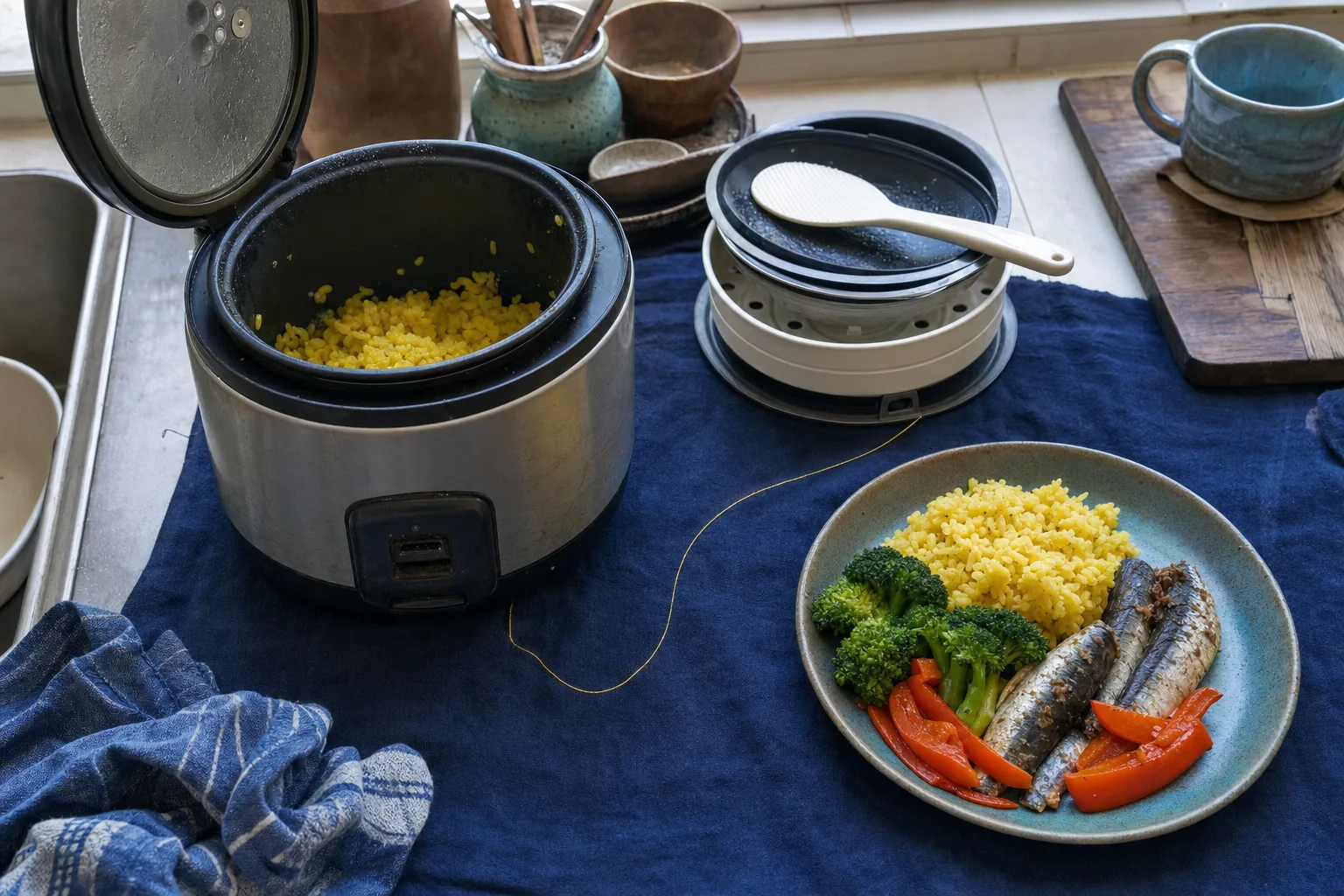
In the channel’s first mukbang, Joe demonstrates a meal he says formed part of his own weight loss. White rice cooks with a pinch of turmeric, onion, and mushrooms while broccoli and a sweet pepper steam above it. He adds a can of sardines packed in olive oil, then finishes with honey-roasted almonds, walnuts, and dried cranberries.
His drink is a small container of grape juice. After making room in the bottle, Joe adds two tablespoons of apple-cider vinegar and takes branched-chain amino acids with it. These ingredients record his personal meal and supplement routine; the video does not establish their suitability or effects for anyone else.
The cooker as a portioning device
Joe’s rice cooker cost roughly twenty dollars. He values the machine less for culinary sophistication than for repeatability: one measuring cup of rice, a fixed vessel, an automatic timer, and a steam tray narrow the number of decisions involved. Cleanup consists mainly of the bowl, lid, paddle, tray, and eating utensil.
He says that fixed capacity also prevents him from preparing too much. Excess food feels like failure because he dislikes waste. A predictable amount, in his account, reduces both uncertainty and the sense that the meal was incomplete.
The template stays stable while selected components rotate. Joe names poultry, fish, mock meat, and different frozen vegetables as alternatives and says he eats red meat or pork less often. That pattern describes his preference at the time rather than a nutritional ranking demonstrated by the meal.
Self-control before calorie precision
Joe says the meal’s central measure is not its exact calorie count but his degree of control. If anticipation becomes frantic, his separate buffer practice introduces a five-minute pause before eating. He presents the timer as a way to enter the meal deliberately instead of treating the plate as relief from an emergency.
Sardines fit his template because he considers them inexpensive sources of protein and omega-3 fats. He also says the nuts and fish improve the balance between omega-3 and omega-6 intake. Those nutritional characterizations are Joe’s; the video lists foods and his reasoning but does not analyze the meal.
Joe contrasts this routine with recent pizza and discourages bread, claiming that its metabolism is unhealthy and can interfere with absorption of some B vitamins. That claim is not supported within the recording and should be read as his opinion, not a finding from the demonstration.
A meal intended to end
Joe eats quickly and regards that as part of the boundary. He reports that his OMAD meals usually last about eighteen and a half minutes and considers completion within twenty minutes a sign of doing well. The numbers are his personal benchmark, not an eating-speed standard established for others.
His aim is to enjoy the food fully without extending the sitting into a contest between wants and needs. Once the prepared meal is gone, he wants attention to move elsewhere. The rice cooker’s deepest value is therefore behavioral: ingredients, portion, timing, and cleanup are already known before hunger begins bargaining.
This recording is less a recipe than a repeatable system. Joe can change the protein or vegetables while preserving the same limited container and short sequence. In his account, mastering that routine matters more to OMAD than perfect cooking or endless variety.