Editorial source note
Thanksgiving Special 2021
Joe uses his family holiday meal to contrast abundance-driven overeating with gratitude and restraint. He shows his own one-plate response and argues that the day need not suspend the usual structure.
Related principles
An editorial summary of views Joe expresses in the linked video. The original recording remains the primary source for his full words and context.
Detailed notes
A closer look at the ideas, examples, and reasoning Joe presents in this recording.
Abundance is the holiday’s harder test
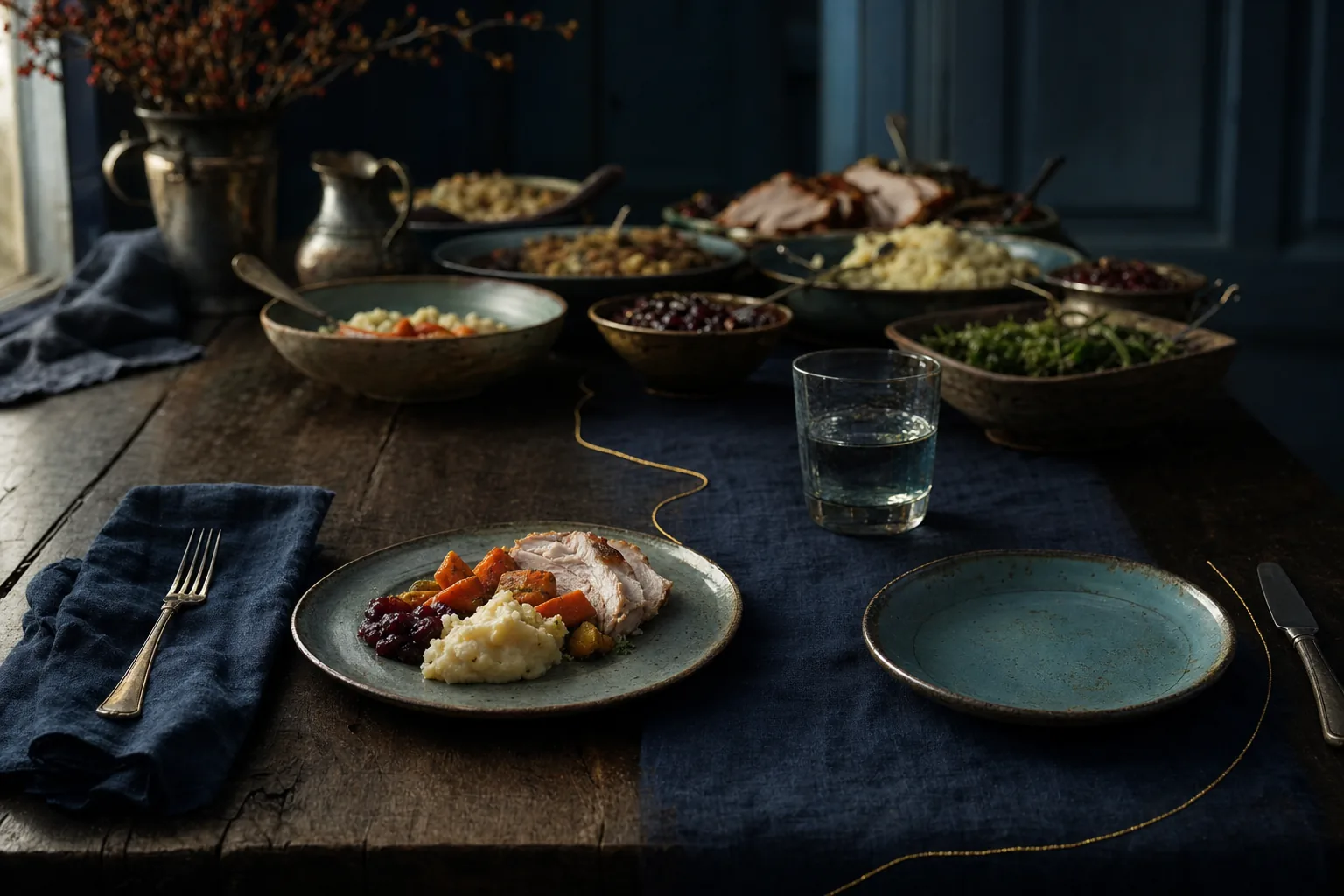
Joe records Thanksgiving from a house busy with two twelve-pound turkeys, casseroles, mashed potatoes, cranberry sauce, and a crowded dessert table. The abundance is not merely scenery. He treats the household’s stress and the scale of the meal as evidence that a holiday about gratitude can become an exercise in anxious accumulation.
When the feast replaces the meaning
Joe places Thanksgiving beside other holidays whose original significance has been overtaken by consumption. In his account, preparing enough food to feel ill has become more legible than giving thanks. The contradiction matters because the surrounding society already provides more food and convenience than earlier generations could assume.
He invokes a post-apocalyptic film in which the lost world is remembered as a time of possessing everything without recognizing what it possessed. Climate-controlled rooms, abundant food, fuel, and air travel become Joe’s examples of ordinary advantages that disappear from view when attention fixes on the next helping.
His plate stays ordinary
Joe’s planned holiday meal is white button mushrooms, a handful of turkey, pork roast, and gravy on one plate. The contents are personal rather than a proposed Thanksgiving menu. His point is that the usual boundary can survive even when the available food is unusually elaborate.
He reinforces the example with a buffet meal from the previous day. Joe reports choosing one plate of meat and stopping, while people around him returned repeatedly because leaving without eating more felt like wasting the price of admission. He interprets that calculation as abundance creating its own pressure: available food begins to feel owed.
Gratitude without suspension
Joe’s answer is not to deny that the holiday meal can be enjoyable. It is to reject the assumption that celebration requires suspension of the structure. Thanksgiving remains another day in his routine, and the feast does not acquire the power to certify happiness or belonging.
This is also why he connects the meal with external validation. Food, spectacle, and the reactions of others cannot supply the contentment that gratitude is supposed to express. Joe locates the holiday’s meaning in accurately seeing what is already present and distinguishing abundance from need. The single plate is his visible form of that distinction: enough food in the midst of more than enough.