Editorial source note
Three False Starts on OMAD - Success Starts Here!
Joe identifies three false starts: expecting ease, endlessly optimizing food, and waiting for a supportive environment. He argues that progress begins under imperfect conditions with self-control as the primary support.
Related principles
An editorial summary of views Joe expresses in the linked video. The original recording remains the primary source for his full words and context.
Detailed notes
A closer look at the ideas, examples, and reasoning Joe presents in this recording.
Three beginnings that turn away from the work
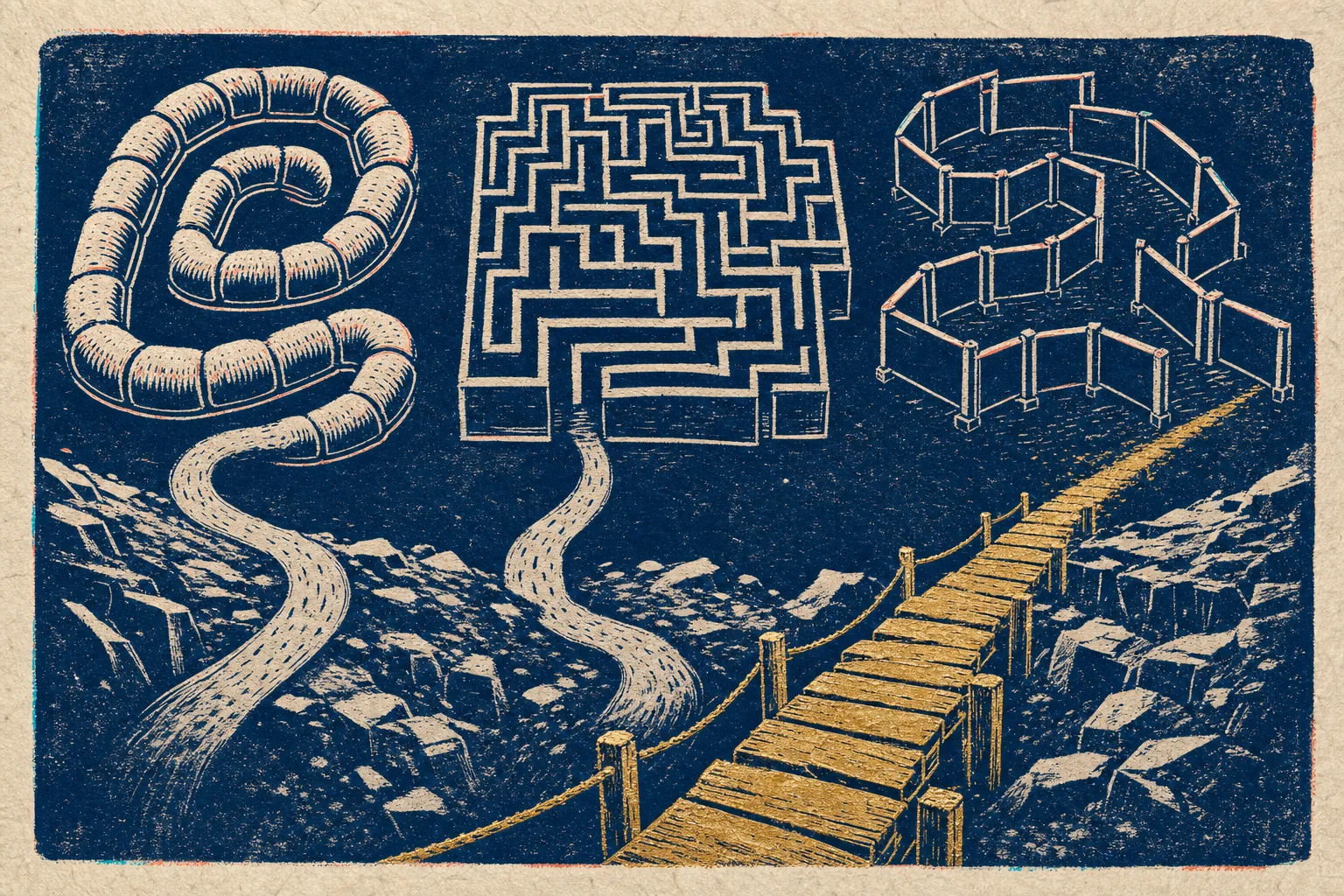
Joe defines a false start as progress made in the presence of an unseen roadblock. The practice appears to be moving forward until an expectation, distraction, or excuse makes continuation seem unreasonable. His three examples are presented as separate for clarity, though he regards them as versions of one underlying problem.
Expecting difficulty to have already ended
The first begins with the thought that the process ought to be easier. Joe says a smoother phase can arrive, but only after the early obstacles have been crossed. Expecting comfort from the outset makes ordinary difficulty look like evidence that the method has gone wrong.
For Joe, the error lies in the initial perspective. The person has imagined an earned ease without yet accumulating the practice that could produce it. When the anticipated smoothness fails to appear, discouragement arrives as a surprise rather than as part of adaptation.
Repairing the menu instead of the practice
The second false start moves attention toward food selection. Joe describes doubts about whether the diet is pure, optimized, or otherwise correct as a form of chasing rabbits: each proposed improvement leads away from the main subject.
He puts self-control ahead of nutritional perfection. In the framework presented here, the current menu is adequate for beginning if it remains inside a controlled meal. Joe expects food choices to evolve as health, needs, and circumstances change, but he does not want that later refinement to postpone the initial boundary.
Waiting for other people to make the setting safe
The third roadblock is a supposedly inadequate support system at home or work. Joe treats coaching, comments, and fasting communities as useful secondary resources. He does not regard them as substitutes for becoming able to support one’s own decision.
His career analogy is intentionally blunt. Someone who refuses an imperfect job while waiting for an ideal position never enters the path along which advancement could occur. Joe applies the same logic to fasting: a workable beginning under imperfect conditions creates possibilities that waiting cannot.
This framing also explains why he calls appeals to the surrounding environment deflection. If progress depends first on another person’s cooperation, responsibility for the practice has been placed somewhere its practitioner cannot control.
One deficit beneath all three
Joe concludes that the three obstacles share a lack of accumulated capacity. He describes that capacity in terms of earned standing and stored good karma: enough prior action to continue after the first enthusiasm has been tested.
His language about personal responsibility is severe, but the conclusion is not that a false start makes success unavailable. Once the recurring pattern is visible, he says, the attempt can be reassessed and begun again with a clearer understanding of what previously diverted it.