Editorial source note
OMAD - Cravings & Lost Opportunities (and Maybe More)...
Joe argues that cravings are unavoidable contests rather than opportunities lost when circumstances become inconvenient. He locates the decisive power in self-control, using travel and social pressure as examples of holding the fasting boundary.
Related principles
An editorial summary of views Joe expresses in the linked video. The original recording remains the primary source for his full words and context.
Detailed notes
A closer look at the ideas, examples, and reasoning Joe presents in this recording.
Pressure reveals where control resides
Joe addresses the moment when inconvenience begins to look like a lost chance to follow OMAD. His examples come from later-life cravings, travel, and meals offered by other people. In each case, he relocates the decisive factor from ideal circumstances to the response made inside them.
A physiological account Joe gives for later cravings
Joe says many of the messages he receives about renewed cravings come from people over fifty. He attributes that pattern to increasing insulin resistance with age, describing cells as less able to obtain sugar from ordinarily eaten food. He further claims that a desire for sweets immediately after a meal can be an early sign of that process. These are the physiological explanations Joe offers in the recording.
His larger point is that an explanation does not remove the contest. The craving identifies the exact difficulty that still has to be faced; avoiding it merely postpones the same encounter.
A challenge that returns until it is met
Joe reaches for stories in which the central confrontation cannot be removed without dissolving the plot. He also compares craving to a video-game opponent that remains at the same level after a failed attempt. A person may pause or retreat, but the unresolved challenge waits at the same point.
The analogy changes the meaning of a hard day. For Joe, pressure is not evidence that the opportunity has passed. It is the opportunity in its most recognizable form, because self-control is being asked to operate when the preferred conditions are absent.
Travel as a smaller meal, not a suspended rule
Travel supplies his practical example. Joe argues that people often loosen a fasting boundary on the road, treating unfamiliar schedules and local food as reasons to eat more. He proposes the opposite response: arrange one small, finite serving in advance and let it constitute the day’s eating.
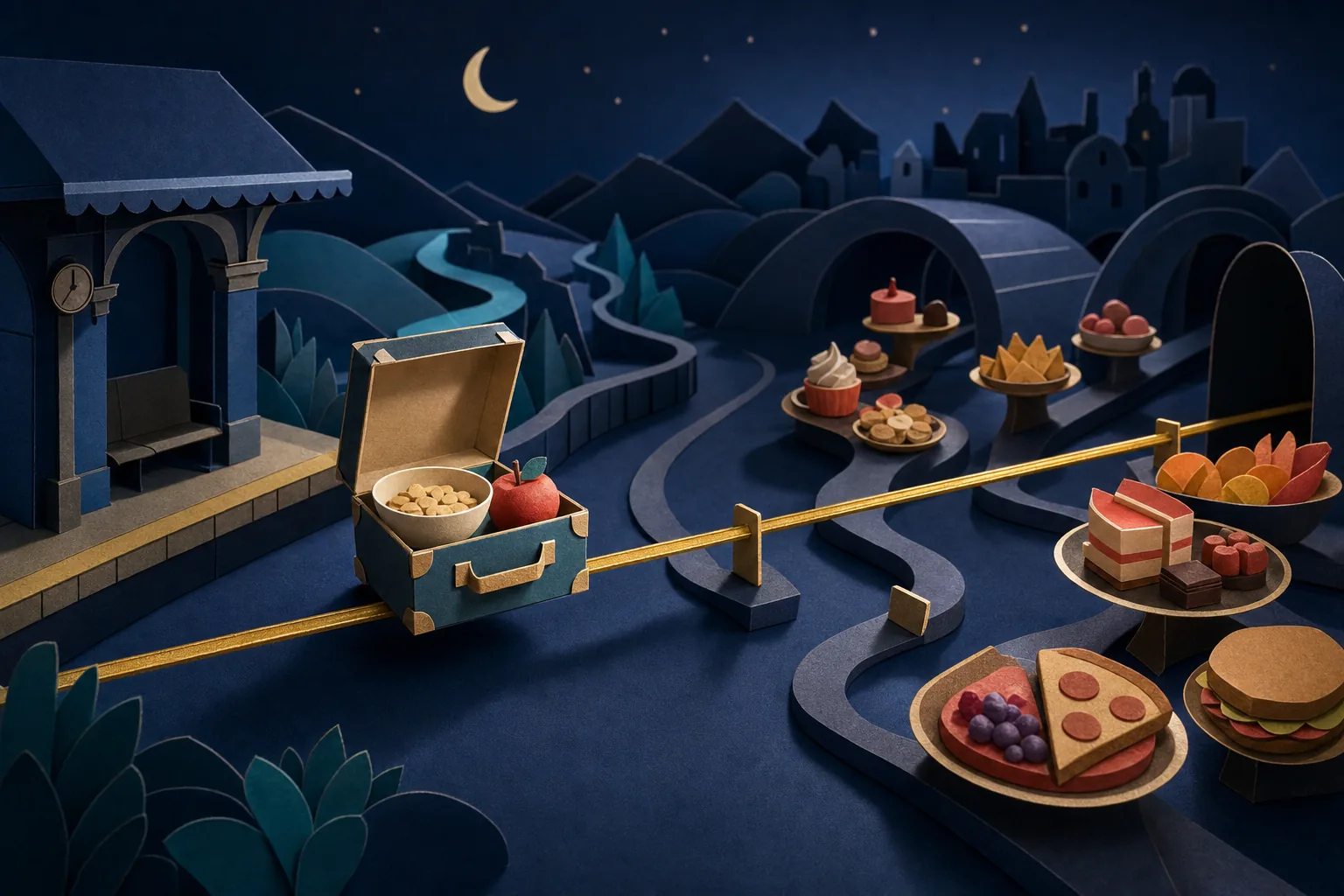
Joe recalls doing this with a bowl of rice and perhaps an apple. The foods are incidental to his argument. He repeatedly rejects the idea that a special ingredient provides the power, locating that power instead in the limit maintained around whatever food is available.
The imagined judgment of other people
Social pressure can make refusal seem offensive. Joe disputes that expectation. He believes people are more likely to respect a calm boundary than resent it, whether the response is that the meal has already happened or that no food is needed.
That confidence may or may not predict every social setting, but it shows how Joe interprets the fear. The anticipated offense is another story capable of moving control back toward the food and the room. His answer is to treat the uncomfortable encounter as the work itself, not as an exception from the work.
The lost opportunity in this recording is therefore not the meal declined or the travel day made austere. In Joe’s frame, the opportunity is lost when pressure is mistaken for permission to defer a challenge that will inevitably return.